
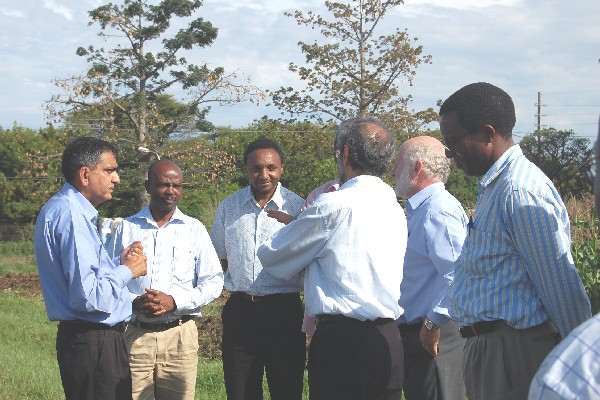
 Dr.Khan, donors and
collaborators
Dr.Khan, donors and
collaboratorsThe Award, which was presented during a special ceremony at the International IPM Symposium in Portland, Oregon, United States in March, is given to individuals or teams who have made significant contributions to the advancement of IPM, with at least one extraordinary achievement. Dr Khan was honored for his work as the leader of icipe's push-pull programme, an innovative strategy that simultaneously controls stemborers and striga weed, the two key constraints of cereal production in Africa. Push-pull was developed by icipe scientists in collaboration with Rothamsted Research in the United Kingdom, Kenya Agricultural Research Institute and various national partners, with funding from Kilimo Trust (East Africa), Gatsby Foundation (UK) and Biovision (Switzerland)."There were many applications with great merit, but Dr Khan's nomination stood out among the select few because it included excellent published documentation on the economic benefits related to IPM adoption, examples of reducing potential human health risks, and a demonstration of minimal adverse environmental effects," said Dr. Sherry Glick, the Awards Chair, International IPM Symposium. Push-pull involves intercropping cereals with a repellent plant such as Desmodium, and planting an attractive trap plant, such as Napier grass, as a border crop around this intercrop. Stemborers are repelled or deterred away from the target crop (push) while they are simultaneously attracted (pull) to the trap crop, leaving the target crop protected. In addition, Desmodium stimulates the germination of Striga seeds and inhibits their growth after it germinates. This combination provides a novel means of in situ reduction of the Striga seed bank in the soil through efficient suicidal germination. Today, more than 30,000 farmers in eastern Africa are practicing push-pull technology on their farms, dramatically improving their cereal yields. In addition, the platform enables small-scale farmers to venture into dairy cattle farming as Desmodium and Napier are both good fodder crops. Moreover, Desmodium fixes nitrogen and helps retain moisture through shading, and is also a perennial crop which is able to exert its Striga control effect even when the host crop is out of season.