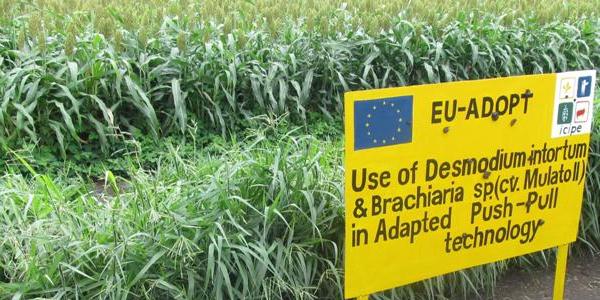
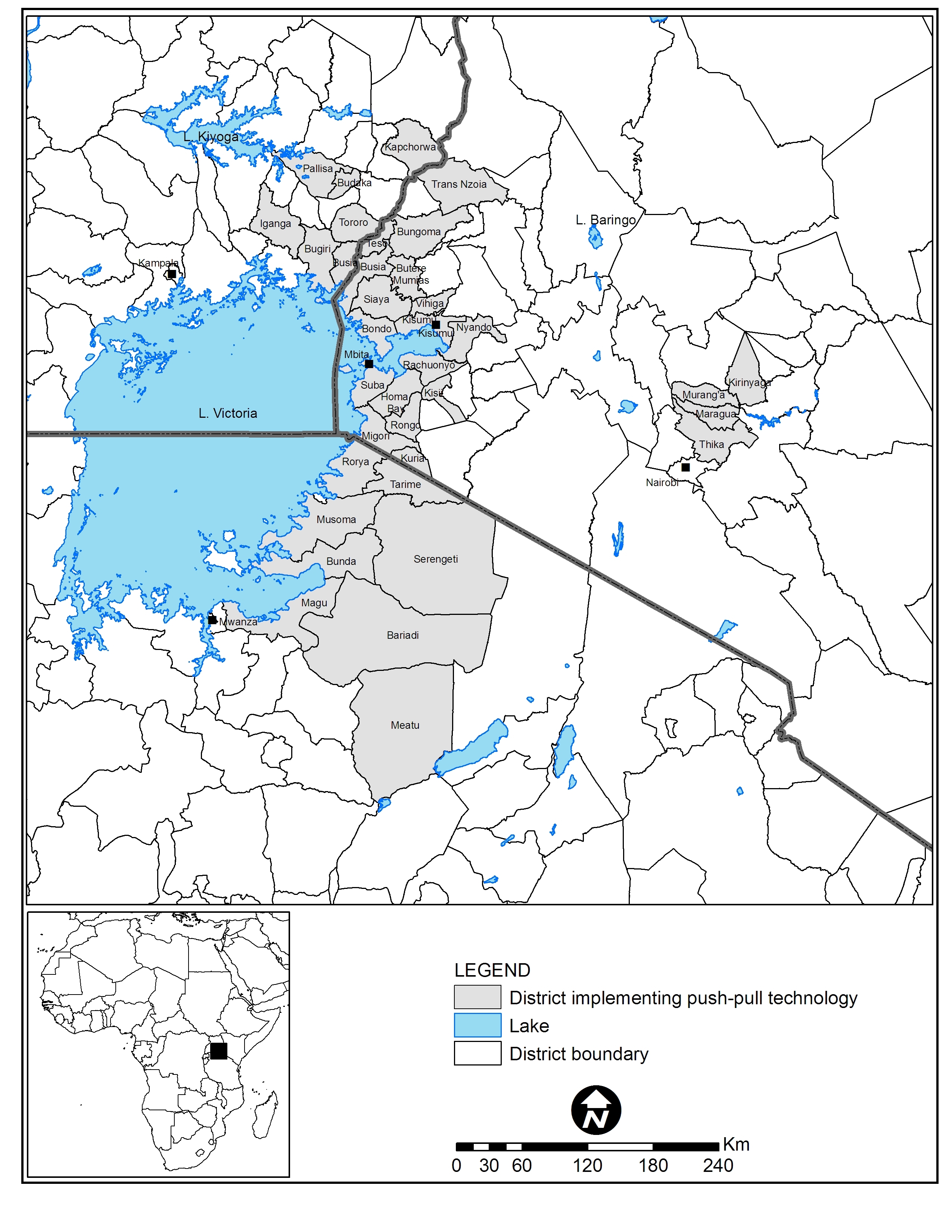
ADOPT (Adaptation and Dissemination of the ‘Push-Pull’ Technology), funded by the European Union, focuses on crops grown in dry areas (e.g. sorghum and millet), and trap and intercrops adapted to dry and hot conditions. New trap and intercrops with adaptation to dry and hot conditions will be identified and integrated as a component companion crops to be utilized in the Push-Pull technology.More....
Objectives
- To generate research results on one of the six priorities to enable policies meant to improve the food security of smallholder farmers
- To create critical mass of research able to answer one of the priorities, drawing on developing countries and European research capacities to generate sustainable bi-regional research partnership
- To ensure that research results, in relevant contexts, are to be implemented in at least 3 developing countries
- To create suitable conditions for dissemination of research results to smallholders
- To improve the exchange of information, experience and knowledge, through scientific and producers' associations networks and (multi-) stakeholder platforms
- To enhance the link between agricultural research and extension programmes, research capacity and institution building, responding to beneficiaries’ needs.
Major Constraints and the action addressing them
| Major constraints |
How the action will address them |
| 1.Low soil fertility |
Increased nitrogen fixation by the intercrop |
2.Degraded land |
Control soil erosion; increased organic matter and soil physical properties |
3.Striga weed |
Striga control by the intercrop, striga seed depletion |
4.Stemborer pests |
Effective stemborer control by companion plants, and natural enemies |
5.Moisture stress |
Soil moisture conservation, improved water holding capacity by intercrops |
6.Low crop yields |
Increased cereal yields (maize from 1 to 3.5t/ha; sorghum 0.8t to 2t/ha; millet 0.4t to 0.8t/ha)19 |
7.Shortage of livestock fodder |
All year round quality fodder from the trap and intercrop plants leading to improved milk production |
8.Loss of biodiversity |
Increased abundance and diversity of beneficial organisms17 |
9.Shortage of labour |
Reduced labour requirement for land preparation and weed control |
Specific results expected at the end of the action include:
- Awareness, interest and ownership created among key stakeholders will establish suitable conditions for dissemination of the technology to smallholders in the target areas and beyond. Additionally, there will be improved exchange of information, experience and knowledge through networks and stakeholder platforms;
- Efficient input production and distribution systems of the selected drought-tolerant trap- and intercrop plants established for scaling up the push-pull technology in target areas and beyond;
- Push-pull technology adapted to drier areas of Kenya, Ethiopia and Tanzania, and adopted by a total of 50,000 households, both female and male headed, in the target countries thereby providing a critical mass of farmers for spontaneous autonomous diffusion within and beyond the target areas resulting in: More....
Related Links
African Science News
Kenya: ICIPE Launches EU-funded Climate Change Project
Adapting to variable climate in east and Horn of Africa
Climate change project launched
Kenya launches new technology for conservation agriculture
Africa, the Green Revolution and Scientists’ Tactics
Affordable Solution to Costly Pests
|