|
ADOPT Project, Funded by the European Union
Specific results expected at the end of the action include:
- Awareness, interest and ownership created among key stakeholders will establish suitable conditions for dissemination of the technology to smallholders in the target areas and beyond. Additionally, there will be improved exchange of information, experience and knowledge through networks and stakeholder platforms;
- Efficient input production and distribution systems of the selected drought-tolerant trap- and intercrop plants established for scaling up the push-pull technology in target areas and beyond;
- Push-Pull technology adapted to drier areas of Kenya, Ethiopia and Tanzania, and adopted by a total of 50,000 households, both female and male headed, in the target countries thereby providing a critical mass of farmers for spontaneous autonomous diffusion within and beyond the target areas resulting in:
(i) Significant improvements in soil fertility, land degradation reversed, abandoned land reclaimed, and agroecosystem integrity enhanced in the target areas;
(ii) Significant increases in grain yields, and food sufficiency/security achieved through control of the major abiotic and biotic constrains;
(iii) Significant improvements in milk and dairy production through provision of year-round quality fodder and improved knowledge on animal husbandry;
(iv) Improved livelihoods resulting in better economic and nutritional wellbeing as well as poverty alleviation in the target areas, with the overall contribution towards attainment of MDGs;
- Human and technical capacities of stakeholders, including national extension systems built for effective and sustainable technology use, thereby enhancing the link between agricultural research and extension programmes. This will also create a pool of experts in the area of conservation agriculture with improved research capacity. It will also create an established backstopping expertise in the region thereby responding to beneficiaries’ needs;
- Strong linkages and collaborations among stakeholders formed and strengthened for subsequent technology refinement, deployment, resource mobilization, and to influence policies meant to improve food security of smallholder female and male farmers. Moreover, the research linkage existing between icipe and Rothamsted Research will be strengthened, while additional linkages between Rothamsted Research and the other participating institutions established;
- Socio-economic impact of the push-pull technology and its impact on gender assessed;
- Publications: At least three publications on socio-economic impacts of push-pull technology and impact on gender in the target areas; At least three publications on the chemical ecology of the new companion plants as affected by climate change and effects on soil health; Popular articles and other aspects of media engaging with the public and farming communities will be contributed throughout and after the proposed work;
- Multiplier effects of the technology in the region achieved: The technology adopted by a critical mass of smallholder farmers in the region thus allowing its autonomous diffusion beyond the target areas; farmers and the communities in the region are expected to benefit as above as push-pull is a platform technology.
|
|
Our Goal
“To end hunger and poverty for
10 million people by extending Push-Pull
technology to 1 million households in
sub-Saharan Africa by 2020”,
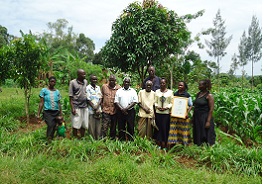
Adopters
|
|
|
|



 Research Partners


